Showing posts with label vegetarianism/veganism. Show all posts

Sunday, October 9, 2011

The Vegetarian Chronicles: Tofurky Beer Brats

For some odd reason, the validation offered by carnivores is important to this vegan. Such approval came a few weeks ago when, while serving my wife and an acquaintance a sampling of Tofurky Beer Brats, both expressed their delight. Pleased with the enjoyment expressed by two people accustomed to meat eating, I decided to renew this experience today after a shopping expedition at Whole Foods.

For only $3.99, I came away with one pack (four brats) of the product offered by Tofurky. The brats themselves feature an enjoyably spicy flavoring along with a thick texture that should satisfy both vegetarians and carnivores alike. Tofurky Beer Brats, like their animal-derived counterparts, should be avoided by those on a diet, though. Although laden with 27 grams of protein, one serving does feature 13 grams of fat with one gram of saturated fat. Carbohydrates are catalogued at 12 grams. This offering is acceptable for vegans as it contains no known animal products, although it does have soy and wheat within.

For those vegans who are also seeking a nutritious and relatively inexpensive source of food, Tofurky Beer Brats are a a worthy option.

Friday, October 7, 2011

The Vegetarian Chronicles: Louis Jadot's Beaujolais

A wine recommendation from someone who finds Marmite palatable may come as a bit of a surprise to some. As vegetarians and vegans may already know, many alcoholic beverages undergo a fining process that often involves the use of animal parts. It is not unlikely that your favorite beer, for example, contains isinglass, a substance derived from the dried swim bladders of fish. For a vegan, finding both acceptable and worthwhile forms of libation can be a challenge. Numerous websites have been set up to guide the discerning vegan in his choices regarding the purchase of alcoholic beverages.

Whereas beer is easier to categorize owing to its uniformity, wine has so many varietals that it is nearly impossible to archive what is vegan and what is not. Fortunately, one famous and dependable product, falls into the list of the acceptable. The product in question is Louis Jadot's Beaujolais. One of the many elements of Beaujolais that its consumers find appealing is that it, in many ways, it is a social denominator, particularly in its home country of France. Beaujolais is unique in that is a product designed for the masses that has a quality usually reserved for products much more expensive. Both rich and poor in France appreciate Beaujolais equally. It is a beverage linked to sociability, a substance appreciated by the aristocrat and the peasant alike. Because it transcends class barriers, it is a favorite of so many.

Louis Jadot's version of Beaujolais is never a disappointment. Retailing for around $10.00 in most U.S. retailers, it is a delightful reminder of how much France has to offer, even for those of us on a strict budget.

The Vegetarian Chronicles: Ethiopian Food

My introduction to Ethiopian food was accompanied with a guffaw of sorts. My parents, resident in New York, had mentioned in passing that they had enjoyed a weekend dinner at an Ethiopian eatery in Manhattan. Ethiopia, forever associated with one of the most dire famines of all time, was an unlikely source of culinary pleasure, or, at least I had thought.

Ethiopia indeed was brutalized by a famine in the 1980s. The horrors of what transpired in that African nation were brought home thanks to the efforts of several well-meaning pop stars in Europe and the United States. Because of this tragedy, the very idea of linking the words "food" and "Ethiopia" were incongruous to most, including me.

The disassociation is a misfortune, although certainly nowhere near as grave as anything that has stricken Ethiopia itself in recent years. For those of us who are constantly in search of satisfying vegetarian cuisine, Ethiopian food is supremely rewarding. My own initiation began in 2000 when my sister invited me to an Ethiopian restaurant in Washington D.C., a city that is home to so many of the Ethiopian diaspora. It was here that I sampled injera, a spongy bread that is used as an eating utensil (forks and knives are rarely dispensed in Ethiopian restaurants as the bread can be curled and used to gather the various dishes) along with such delights as shuro watt, kik alitcha and misir watt.

A true love arose that summer afternoon in D.C., one that would inspire me to sample Ethiopian cuisine in Rome, Paris and in my current city of Tempe, Arizona. It is here where I have the good fortune to live within walking distance of the Blue Nile, situated at 933 E. University Dr. Suite 112 Tempe, AZ 85281. The Blue Nile is owned by Abel, an affable Ethiopian expat and tended to by his lovely Kuwaiti wife. The two maintain the highest standards of professionalism, and I have never been disappointed in my many outings to their establishment. Another place for Ethiopian cuisine in Tempe is Lalibela; however, my strict loyalty to my first source of Ethiopian cuisine in Tempe has kept me from frequenting their rival, although I am sure that they offer excellent fare.

The spiciness of Ethiopian cuisine is well complemented with one of the many beers offered from that nation. Two I have had the good fortune to try are Harar and Hakim, both particularly pleasing, especially when imbibed along with the piquant food. As for Ethiopian wine, my samplings have been very limited. Ethiopian honey wine is frequently sold at Ethiopian restaurants and the treacly concoction is not to my liking, but may appeal to those who do not object to the super sweet.

Few countries have can boast a cuisine so rich that it would inspire me to make a pilgrimage to the nation itself, but Ethiopia, along with France, Italy, Korea, China, Japan, the nations of the Middle East and Greece, holds that distinction. Although I have not been to this country which hosts an ancient civilization, it is one of my top travel priorities. Never have I been disappointed by Ethiopian food and the quality of Ethiopian eateries in all the cities where I have sampled it has been supreme. It is for that that I recommend it heartily to both vegetarians and carnivores alike.

Thursday, October 6, 2011

The Vegetarian Chronicles: Kim'chi


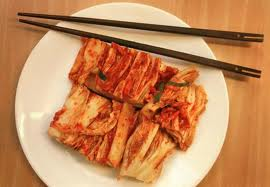
Tonight's showing of Kim'chi Nation by PBS has inspired me to write something which may be of use to fellow vegetarians. Some may ask, "what is kim'chi?" This is not an unreasonable question as its popularity does not extend very far beyond the borders of Korea. Although a staple of Korean cuisine and always available on the menus of Korean restaurants, it does not have the same name recognition that other foods from Asia have in the West.

In March of 1997 I moved to Seoul to begin a new phase of my life as an English teacher. In addition to the generosity of the Korean people, one of my fondest memories of my time in the South Korean capital is of its food. Even as a vegetarian, I was never at a loss for culinary treats, all of them of superlative quality.

Along with cold noodles and piquant sauce and several other pleasing dishes, one new element was added to my diet and that was kim'chi. Kim'chi is simply cabbage that has been fermented and spiced. For most Koreans, a dinner without at least a side dish of Kim'chi is inconceivable. Kim'chi is everywhere in Korea. One can buy packets at Lawson's, a counterpart to 7-11. One can also purchase it at neighborhood green grocers. Nowhere will you find food dispensed without the traditional Korean dish being within reach.

Kim'chi is available at Asian speciality shops. Here in metro Phoenix, I am reliant on the Asian Market in Mesa. Korean restaurants are gaining in popularity and, although far more obscure than their Japanese and Chinese counterparts, are likely to garner more and more positive attention.

Kim'chi, as I mentioned, is a side dish. Its nutritional value is nearly non-existent. It is also an acquired taste, but for those who do acquire it, it is a delicious addition to rice dishes and several other offerings.

Wednesday, October 5, 2011

Vegetarian Chronicles: the unlikely love of Marmite

Despite having spent a significant amount of time in my mother's birthplace of Ireland, I was not introduced to Marmite until adulthood. Exposed to kippers, black pudding and sausage in childhood, my conversion to vegetarianism at age 19 could be seen as inevitable. The vegetarian life has had far more rewards than limitations. One element, though, that will not likely find favor among my fellow Americans, is my affinity for Marmite.

Marmite is a yeast extract that is packaged in brown bottles bearing an easily recognizable yellow decal. Beloved by the British, who have been its primary consumers for a century, Marmite is an established staple of British cuisine, one of the most reviled upon this Earth. Although mostly in accordance with those who have a distaste for the stereotypical British diet, there are some reservations I must make. Marmite, unlikely to become a cultural phenomenon in the United States, is an excellent source of vitamins for a vegetarian. Wholly vegan, the yeast extract contains no fat, no carbohydrates, 2 grams of protein (per 4 grams, the standard serving) and a generous helping of Vitamin B. Marmite will only appeal to a small segment of American vegans looking for nutrition, but those whose taste buds accept it, will find a rewarding, inexpensive addition to their diet.

Marmite can be purchased on the Internet on several on-line shops that specialize (or specialise) in British goods. Here in Tempe, Arizona, I am able to purchase it for $5.99 per container (125 grams) at Fresh & Easy, a subsidiary of Tesco. If you are a lacto-vegetarian, you can also utilize this shop to stock up on Aeros, Flakes and other offerings from Cadbury.

The quest for Marmite began after I had the good fortune to come across it in a corner of the former British Empire this summer. This land is Guyana, and Marmite can be purchased in several shops where the British legacy is still apparent. Unfortunately, while en route to the other Guyanas and neighboring Brazil, my container of the beloved yeast extract was left behind on a bus, and I had no such luck finding it in the nations of Latin America.

To date, never a week goes by without a trip to Fresh & Easy for a reliable source of protein and vitamins. I have no delusions of a mass conversion among my fellow Americans, but I am hopeful that at least one person will share my affinity.

Monday, July 18, 2011

The Vegetarian Chronicles: "so where do you get your protein?"

As a vegetarian I find not only the consumption of meat distasteful, but also my more militant counterparts who evangelize this diet and use tactics for eliciting shame from carnivores. Near fanatical proselytizing only engenders contempt, not conversion. What does tend to influence people to adopt a vegetarian diet are those who are no more vocal about their dietary habits than their choice of detergent and who, beyond a certain age, demonstrate physical well being, a level of healthiness surpassing their peers. The knowledge that they are vegetarians can be obtained through simply dining with such individuals.

Yet, the concept of the healthy vegetarian or vegan is often overshadowed by those who approach the diet in a foolhardy fashion and find themselves stricken with anemia, malnutrition, a generally sickly pallor and other maladies. Because of these cases, the oft-repeated question one receives is, "so where do you get your protein from?" The smart aleck in me wants to respond with, "Food! Where'd you think I got it from, copper wiring and topsoil?"

My foray into veganism began in January of 2010 and, ironically, has enriched my diet far more than when I was merely a vegetarian often relying heavily on dairy products as a source of protein. Once again, it is possible to call oneself a vegetarian if one subsists -for however long the body will allow it -on Ramen noodles, pizza and beer, but such a practice will sway few people, if any. The variety of a vegan diet made itself evident yesterday as I compiled a list of groceries for the weekly run to the supermarket. My list went as follows:

Garbanzo beans
Black beans
Pasta
Tomato Sauce
Potatoes
Brown rice
White rice
Soy meat (veggie burgers, salami, hot dogs, chorizo, etc.)
Lettuce
Vinegar dressing
Vegetable soups
Baked beans
Pinto beans
Hummus
Pita bread
Lentils
Soy sour cream
Soy mayonnaise
Avocados (for making guacamole)
Nachos
Salsa
Coconut milk ice cream bars
Soy milk
Tofu (can be made into a delicious dish using several recipes, particularly from Korean cookbooks)

These are just some of the items that sustain me. In addition to buying my own food, several restaurants are well suited to vegetarians/vegans, e.g., Ethiopian, Middle Eastern, Italian, Indian, and to a certain extent, Korean.

One issue that should be raised is excess reliance on soy. While studies are not definitive, an abundance of soy products has been shown to be a potential hazard to female health, thus moderation is essential.

The vegan diet has been profitable to me in terms of health, but to sustain it, regular consumption of multivitamins plus B-12 vitamins are vital.

Returning to the popularization of the diet, it is important to remember that you have undertaken something by choice. Excess preaching, badgering and attempts to induce guilt will only result in a backlash. As it is a choice, make sure that you reflect in your body itself just how healthy a choice this can be if undertaken in the right way. Most individuals are intrigued by those who appear to age slowly, thus a person whose weight is within normal range may exhibit that, and responsible vegetarianism is often a good way to stave off obesity. The point is to be an example, not a fanatical proselyte. The dietary choice you have made is one that will benefit this Earth and your conduct, if reasonable, may draw converts while its polar opposite may engender mistrust of vegetarians as well as disdain.